How much does a WordPress website cost in 2026?
- Wordpress
- 7 min read
- Ahsan
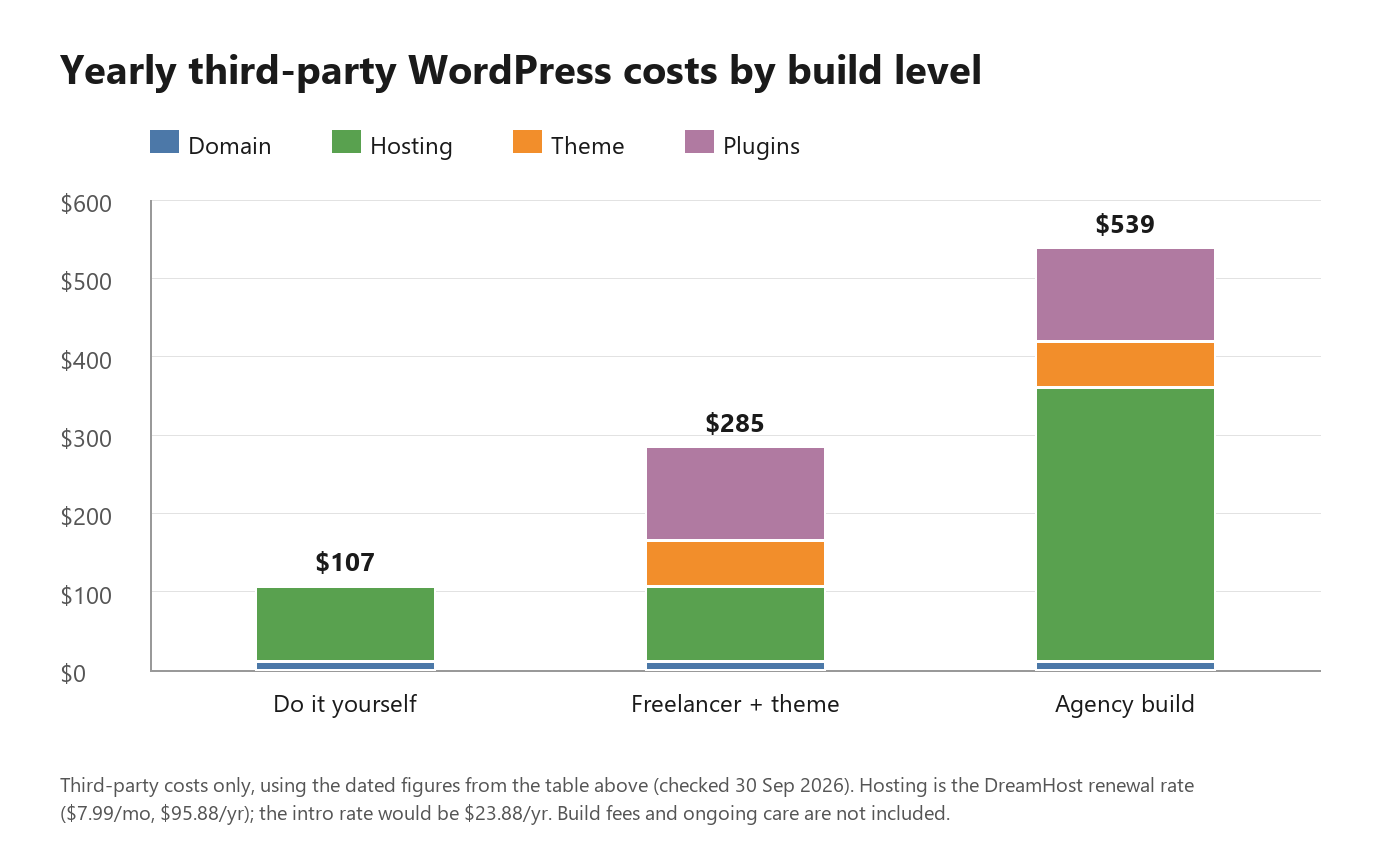
The WordPress software is free. The website isn’t. So how much for WordPress, in real money? You pay for 6 things: a domain, hosting, a theme, plugins, the build and upkeep. Built yourself on a free theme, it’s about $35 a year while intro hosting prices last and about $107 a year after. A freelancer build usually adds $1,500 to $5,000 and an agency build $5,000 to $15,000, depending on scope. Every price below is dated.
That figure is a .com at about $11 a year plus entry-level hosting at $1.99 a month, paid upfront for 4 years, which then renews at $7.99 a month.
We’ve built WordPress sites for 12+ years as a web design and development company, and the question we hear most is why one quote is a few hundred dollars and another is several thousand. This guide goes line by line.
How much is WordPress itself?
WordPress itself costs nothing: the software from WordPress.org is free, and WordPress.com is a separate paid service that hosts it for you. There are 4 things to know:
- WordPress.org is free, open-source software. It’s released under the GPLv2 (or later) license. You download it, install it on hosting you pay for, and own everything.
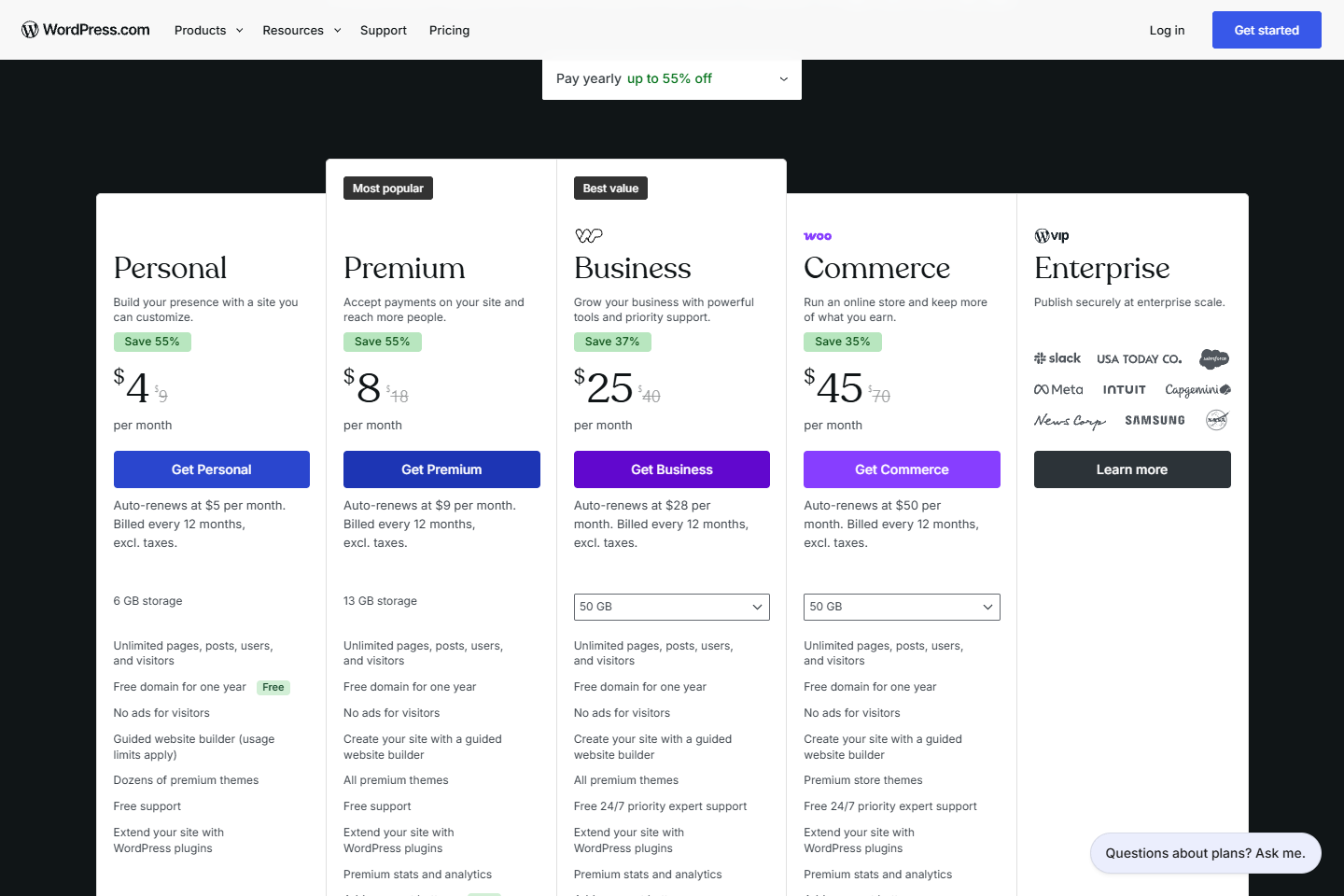
- WordPress.com is hosted WordPress with plans. Billed yearly, the regular rate is Personal $60 a year ($5 a month), Premium $108 ($9), Business $336 ($28) and Commerce $600 ($50). The plan cards show a lower first-year price, then renew at these rates. Paying month to month costs $9, $18, $40 and $70.
- Plugins work on every paid WordPress.com plan. WordPress.com’s own help page lists Personal, Premium, Business and Commerce.
- There’s a free WordPress.com plan too. It’s fine for trying WordPress out, but it won’t give you a business site on your own domain.
The 6 costs of a WordPress website
A WordPress website has 6 costs: domain, hosting, theme, plugins, the build and ongoing care. The first 4 have public prices; the last 2 depend on who does the work.
| Cost | Typical range (from official pricing pages) | One-off or yearly |
|---|---|---|
| Domain | About $11 a year for a .com at Porkbun. Cloudflare Registrar sells at cost with no markup. | Yearly |
| Hosting | $1.99 a month on DreamHost’s entry plan (4-year prepay, renews at $7.99) up to $35 a month for Kinsta’s single-site managed plan ($350 a year paid annually) | Monthly or yearly |
| Theme | $0 for a free theme, or $59 a year for GeneratePress Premium | Yearly |
| Plugins | $0 for free plugins, or from about $59 a year per premium plugin (Gravity Forms Basic $59, WP Rocket Single $59.95) | Yearly |
| Build | Your time, or a freelancer’s or agency’s quote | One-off |
| Care | Your time, or a monthly care plan | Monthly or yearly |
Watch the hosting line. Intro prices usually need a long prepay, and the renewal rate is what you’ll pay for years.
How much for WordPress if you build it yourself?
If you build it yourself, the cash cost is small and the real cost is your time. You pay with evenings.
There are 5 jobs you take on when you build your own site:
- Setup. Buying hosting, pointing the domain, installing WordPress and adding SSL.
- Design. Choosing a theme and making it look like your business on a phone as well as a laptop.
- Content. Writing every page, finding photos and making the contact form send to the right inbox.
- Basics most people skip. Backups, security, speed, analytics and a sitemap for Google.
- Upkeep. Updating WordPress, the theme and every plugin, and fixing whatever an update breaks.
The honest limit: WordPress won’t write your pages, pick your photos or update itself safely. If you enjoy that kind of work, DIY is a good deal. If you’d rather spend those hours with customers, the time is the expensive part.
What a freelancer or agency build costs, and what moves the price
A freelancer working from a theme usually costs less than an agency build, and 5 things move either quote up or down. The one to plan for is content. Owners often mean to write the pages themselves, run out of time, and then the launch slips or copywriting gets added to the quote. E-commerce is the next biggest jump.
These are the 5 drivers that move a WordPress quote:
- Number of pages. A 5-page brochure site and a 40-page site are different jobs. Each page needs layout, content and testing.
- Custom design. Adapting a good theme is faster than designing every screen from scratch. Custom design is worth it when your brand has to stand apart.
- E-commerce. A store adds products, payments, shipping, tax and order emails. If you sell online, you’ll want a WooCommerce development service that has run stores before, because checkout bugs cost real sales.
- Integrations. Connecting the site to your CRM, booking calendar, email marketing or accounting takes setup and testing on both sides.
- Content writing. Many quotes assume you supply the words and photos. If the builder writes them, expect a higher price.
At Tech Artisans we quote after a 20-minute call, because scope varies. A typical build of ours uses a premium theme such as GeneratePress Premium and a few licensed plugins. We hold agency licenses, so that cost sits inside our care plan instead of a yearly renewal per site. Whoever builds your site, ask what you’ll have to renew each year.
The yearly costs after launch
After launch, you’ll pay every year for hosting, the domain, premium licenses and someone’s time to keep the site updated and backed up.
There are 4 costs that come back every year:
- Hosting and domain. The renewal rate, not the intro rate. On DreamHost’s entry plan that’s $7.99 a month after the first 4 years.
- Licenses. Premium themes and plugins renew yearly for updates and support. GeneratePress Premium renews automatically each year, and Rank Math PRO renews at €8.99 a month billed annually (Rank Math lists its prices in euros).
- Updates. WordPress, your theme and each plugin release updates, including security fixes. Someone has to apply them and check nothing broke.
- Backups and monitoring. Some hosts include daily backups; check that they’re off-site and that someone has tested a restore.
You can do all 4 yourself, or pay for website maintenance services so a developer handles them.
Where cheap sites cost more later
A cheap build often costs more over 2 or 3 years than a fair one, because the savings come back as rebuilds, slow pages and emergencies. There are 3 ways it usually shows up:
- The rebuild. A site built on a heavy page builder or an abandoned theme can be hard to change. When you need new pages or a refresh, the cheapest fix is often starting over.
- Plugin bloat. A plugin for every small feature slows the site, raises the licensing bill and makes each update riskier, because more code can conflict.
- No one to call. The builder moves on, an update breaks the contact form, and you find out a month later when the leads stop.
Pirated (“nulled”) themes are a common shortcut on cheap builds, and one of the usual ways sites get hacked. The cleanup can cost more than the original build.
How to compare WordPress quotes
Compare quotes by asking every builder the same 6 questions, so the prices line up.
- What exactly is included? Pages, design rounds, content, forms, SEO basics and training.
- Who owns the site? You should own the domain, hosting account, theme and plugin licenses, and all content.
- Which theme and plugins will you use, and what do they cost each year?
- Who writes the content, and who supplies the photos?
- What happens after launch? Who applies updates, and what does support cost?
- Can I see 2 or 3 sites you built, still live?
If you’d rather have it built, here’s what to ask when you compare wordpress design companies, and how a quote should be scoped. A clear quote prices each part on its own line: design and how many rounds of changes, the number of pages, forms and integrations, SEO setup, content if they write it, training, and what happens after launch. If a quote is one number with no breakdown, ask for one.
FAQ
Is WordPress free?
Yes. The WordPress software from WordPress.org is free and open source, released under the GPLv2 (or later) license. What costs money is everything around it: a domain, hosting, any premium theme or plugins, the build and upkeep. WordPress.com is a separate hosted service with a free plan and paid plans, which is where much of the confusion about the price comes from.
How much does WordPress hosting cost?
WordPress hosting runs from about $2 a month on intro shared plans to $35 a month or more for managed hosting. DreamHost’s entry plan is $1.99 a month on a 4-year prepay, renewing at $7.99. Kinsta’s single-site plan is $35 a month. Budget for the renewal price, not the intro deal.
Do I need premium plugins?
No. Many small-business sites run well on free plugins alone. Premium plugins make sense when they save real time or add something you need, such as advanced forms, caching or a store feature. Each one is a yearly bill and more code to update, so add them for a reason and remove the ones you stop using.
Is WordPress cheaper than Wix or Squarespace?
No, not always. WordPress hosting can cost less per month, and you own the site. Squarespace’s Basic plan is $12 a month billed annually, with hosting included. Wix’s Light plan is $17 a month billed annually. WordPress needs more upkeep, so count your time or a care plan.
How much does a WordPress site cost per month?
A small WordPress site you run yourself can cost under $10 a month: renewal-rate shared hosting at $7.99 plus about $1 for a .com domain. Premium licenses add a few dollars more. A managed host, or a care plan where someone else handles updates and backups, moves the monthly number up.
Should I pay for a custom theme?
No, usually not. A well-built theme such as GeneratePress, adapted to your brand, covers most small-business sites for a yearly license of $59. A custom theme makes sense when your design can’t be built from a theme’s options, or when speed and uniqueness matter enough to pay for design and code from scratch.
Not sure what your quote covers?
Most quotes don’t show the line items, and that’s where the surprises hide. Send us the quote you got; we’ll tell you what’s in it, what it leaves out and what you’ll pay each year after launch.

Ahsan Shahid, CEO
Ahsan spent 12+ years as a lead developer on Drupal and WordPress projects before building the team behind Tech Artisans, and still reviews the technical work on client projects.
More about us