
Local SEO for small businesses: a practical guide
- SEO
- 9 min read
- Ahsan
Local SEO for small businesses is the work that gets you into Google’s map results and local searches when someone nearby looks for what you sell. Google says it ranks local results on 3 things: relevance, distance and prominence. You can’t change how far a searcher is from you. You can change the other 2, and this guide gives you the order to do it in, with about 2 hours a week.
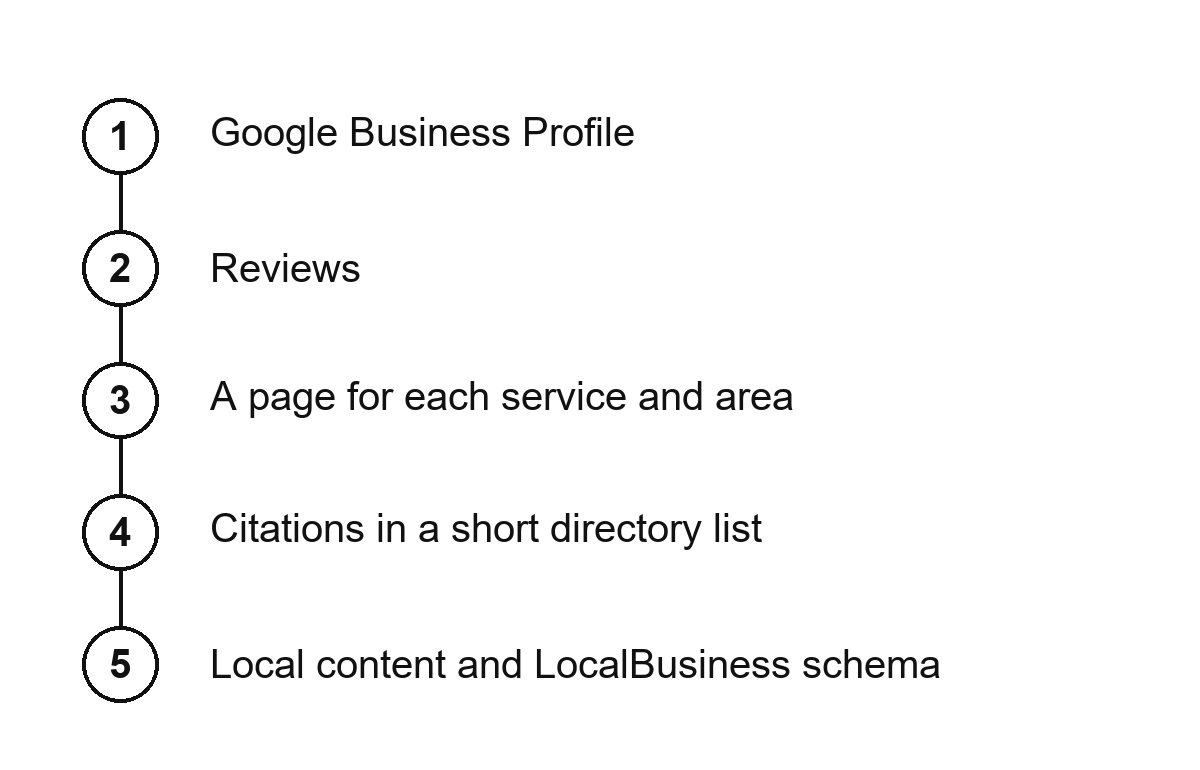
There are 5 steps, in the order we’d tackle them as an seo company for small business:
- Your Google Business Profile.
- Reviews.
- A page for each service and area you serve.
- Citations in a short list of directories.
- Local content and LocalBusiness schema.
Why local SEO is important for a small business
Local SEO matters because people searching for a plumber, a dentist or a bakery nearby usually want one soon, and Google shows them a short list of local businesses with reviews, hours and a call button. If you’re not in that list, those searchers may never see you.
You can’t buy your way into it, either. Google says there’s no way to request or pay for a better local ranking. That’s good news for a small business: the same 3 competitors who show up every time got there through things you can work on too.
Step 1: your Google Business Profile
Your Google Business Profile comes first, because it’s the listing that shows in the map results. Start by claiming it, then verify your Google Business Profile: Google lists verification as its first tip for local ranking.
Then fill in everything. Google says businesses with complete, accurate info are more likely to show in local results. That means 6 things:
- Name: your real-world name, exactly as it’s on your sign. Adding keywords to it breaks Google’s rules and can get the profile suspended.
- Categories: as few as possible, as specific as possible.
- Hours: regular hours plus holiday hours.
- Services: every job you do, named the way customers say it.
- Service areas: if you travel to customers, up to 20 cities or ZIP codes, within about 2 hours’ drive of your base.
- Photos: your storefront, your team and real finished work.
Set it up once, then check it every month. If you’d rather hand it off, it’s what our google business profile optimization services cover.
Step 2: reviews
Ask every customer for a review, reply to the reviews you get, and never pay or trade for one. Reviews feed prominence, and Google says more reviews and positive ratings can help your local ranking.
How to ask. Google lets you create a review link or QR code from your profile. Send the link by text or email soon after the job, while it’s fresh.
A simple setup to copy: text every customer soon after the job is done, something like “Thanks for having us out today. If you have a minute, a Google review helps a lot,” plus your review link. Send one reminder a few days later, then stop.
How to reply. Keep replies short and specific, and skip the sales pitch. For a bad review, stay polite, don’t share anything private about the customer, and offer to sort it out by phone or email.
What’s banned. Google’s rules and a federal rule both apply. There are 4 things to avoid:
- Offering a discount, freebie or payment in exchange for a review, or for changing or removing one.
- Asking only happy customers, or discouraging unhappy ones from posting. Google calls this selectively soliciting positive reviews.
- Buying reviews, or posting fake ones, including AI-written ones. The FTC’s rule on consumer reviews bans this, and it’s been in effect since October 21, 2024.
- Reviews from your managers or staff that don’t disclose the connection, and threats to get a bad review taken down. The FTC can seek civil penalties for knowing violations.
This is a plain-English summary, not legal advice.
Step 3: a page for each service and area you serve
Give each service its own page on your website, and add an area page only when you have something real to say about that area. Relevance is about how well you match what someone searched, and a page called “Water heater repair” matches that search better than a home page that lists 12 services.
A good service page answers 5 questions: what the job is, how you price it, what it looks like when it’s done (real photos), which areas you cover, and what customers ask before they book. A roofer, for example, needs separate pages for repair, replacement and inspections before any city page. We go deeper on trades on our contractor seo page.
What not to do: copy one page 50 times and swap the city name. Google’s spam policies call pages built for specific cities that funnel visitors to one place “doorway abuse”. These pages rarely help, and they can hurt.
A common mistake: a site publishes the same page for every town it serves with only the city name changed. Google indexes a handful of them, and those bring almost no clicks. Removing the copies and putting the effort into real service pages is usually the better move.
Step 4: citations and the local business directory list worth your time
A citation is a listing of your business name, address and phone number on another site, and a handful of accurate ones beats hundreds of sloppy ones. Google says prominence is based partly on how many websites link to your business.
Here’s our local business directory list. There are 6 listings worth claiming first:
- Apple Business, which manages how you appear in Apple Maps. It used to be called Apple Business Connect, and your existing sign-in still works.
- Bing Places for Business.
- Yelp for Business.
- A Facebook business page.
- A Nextdoor business page.
- Your trade’s main directory: Angi or Houzz for contractors, Healthgrades for clinics, Avvo for lawyers.
Use the exact same name, address and phone on every one, matching your Google Business Profile. Skip paid bundles that promise to push your details to hundreds of sites. The listings that matter are on this list, and you can claim them yourself. Citations won’t rescue a weak profile, so do this after steps 1 to 3.
Step 5: local content and LocalBusiness schema
Once the basics are live, publish content about real local work and add LocalBusiness structured data so Google reads your name, address and hours correctly.
Local content is anything a customer in your area would find useful: a write-up of a finished job with photos, answers to the questions you hear every week, or a seasonal checklist for your trade. One good post a month beats 4 thin ones.
LocalBusiness schema is code on your site that spells out your business details for search engines. Google’s documentation says to use the most specific type you can (a plumber, a dental clinic), and it requires only 2 properties: your name and address. It recommends adding your phone, website, opening hours, map coordinates and an image. On WordPress, most SEO plugins can add it for you. Test it in Google’s Rich Results Test.
Honest limit: schema helps Google understand you, but Google doesn’t guarantee it’ll show anything special in results.
An SEO checklist for local small business websites
The checklist has 10 items, one line each:
- Name, address and phone on the site match your Google Business Profile exactly.
- The phone number is tap-to-call on mobile.
- Each service has its own page.
- Each page title names the service and the main area you serve.
- The areas you serve are listed in plain words.
- The contact page has hours and, if customers visit, directions.
- LocalBusiness schema passes the Rich Results Test.
- Photos are of your real work, team or premises, not stock.
- Reviews or testimonials sit near the call-to-action button.
- Search Console is set up, so you can see which searches find you.
The benefits of local SEO for small businesses, and its limits
The benefit is a steady stream of calls, direction requests and website visits from people nearby who already want what you do, with no cost per click. The limit is time: some changes show up in minutes, but rankings move over months, and part of the result is outside your control.
Here’s what Google says about timing. Profile edits usually show within about 10 minutes, and some take up to 30 days. Service area changes can take up to 48 hours. How long it takes to move up depends on how many competitors you have and how much work they’ve already done.
There are 3 limits no one can fix for you:
- Distance. You won’t show at the top for someone 30 miles away when there’s a good match next door.
- Payment. Google doesn’t sell local rankings.
- Guarantees. Google changes how it ranks, so anyone who promises you the top spot in the map results is guessing.
Track progress in your profile’s performance report, which shows calls, direction requests, website clicks and the searches people used to find you.
A typical first month: fix the profile’s primary category, add any missing services, and split a catch-all services page into one page per service. Then watch calls and direction requests in the performance report for a few months.
Do it yourself or hire help
You can do every step here yourself. If you’d rather spend those hours on the business, a local seo agency does it on a schedule and reports back.
Doing it yourself works well for steps 1, 2 and 5: nobody knows your jobs and customers better than you. Setting up schema, fixing a site with dozens of thin pages, or cleaning up old listings are the jobs worth handing off, because they’re technical and slow the first time.
Whoever you hire, monthly local SEO work should include profile updates and posts, review requests and replies, new service or project pages, and listing cleanup. Ask for a short report each month that shows calls, direction requests and what was done.
Whoever does it, 3 things are off the table: buying reviews, building fake city pages and promising rankings. We don’t do any of them.
FAQ
How long does local SEO take?
It depends on your area and your competitors. Google says profile edits usually show within 10 minutes and sometimes take up to 30 days, but ranking changes take longer. Plan to measure progress in months, not days, and track calls and direction requests in your profile’s performance report instead of checking your position every morning.
Can I do local SEO myself?
Yes. Every step in this guide is something an owner can do: claim and complete your profile, ask for reviews, write a page for each service, claim a handful of listings and publish real local content. The hard part is keeping it up week after week. Setup takes the most time, and after that most of the work is reviews and occasional new pages.
Do I need a website for local SEO?
No, but it helps a lot. A verified Business Profile can appear in map results without a website. A site gives Google more to judge relevance by, gives customers somewhere to check your services and prices, and is where your profile’s website button sends people. Without one, you’re relying on the profile alone to answer every question a customer has.
Does posting on Google Business Profile help?
Yes, mostly with customers. Posts show offers, events and updates on your profile in Search and Maps. Google’s own tips for improving local ranking don’t mention posts, though, so treat them as a way to keep your profile current and useful. A post about a finished job or a seasonal offer is worth the 5 minutes.
Should I buy reviews?
No. Google bans paying or offering anything in exchange for reviews, and it can restrict profiles that break its rules. The FTC’s rule on consumer reviews also bans buying fake reviews, and it allows civil penalties for knowing violations. Ask every customer instead.
How much does local SEO cost?
It ranges from your own time, if you do it yourself, to a monthly fee if you hire help. Claiming your Business Profile costs nothing. What you pay an agency depends on how many locations and services you have and how competitive your area is. Our seo pricing page covers how we price it.
Where to start this week
Start with your profile this week, and ask your last 5 customers for a review. If local SEO is one more job on a list that’s already too long, tell us what’s eating your time. We’ll tell you honestly what’s worth doing yourself and what we’d take off your plate.

Ahsan Shahid, CEO
Ahsan spent 12+ years as a lead developer on Drupal and WordPress projects before building the team behind Tech Artisans, and still reviews the technical work on client projects.
More about us